

Smart Fertilizers Market Manufacturers & Suppliers Company Analysis 2026-2035
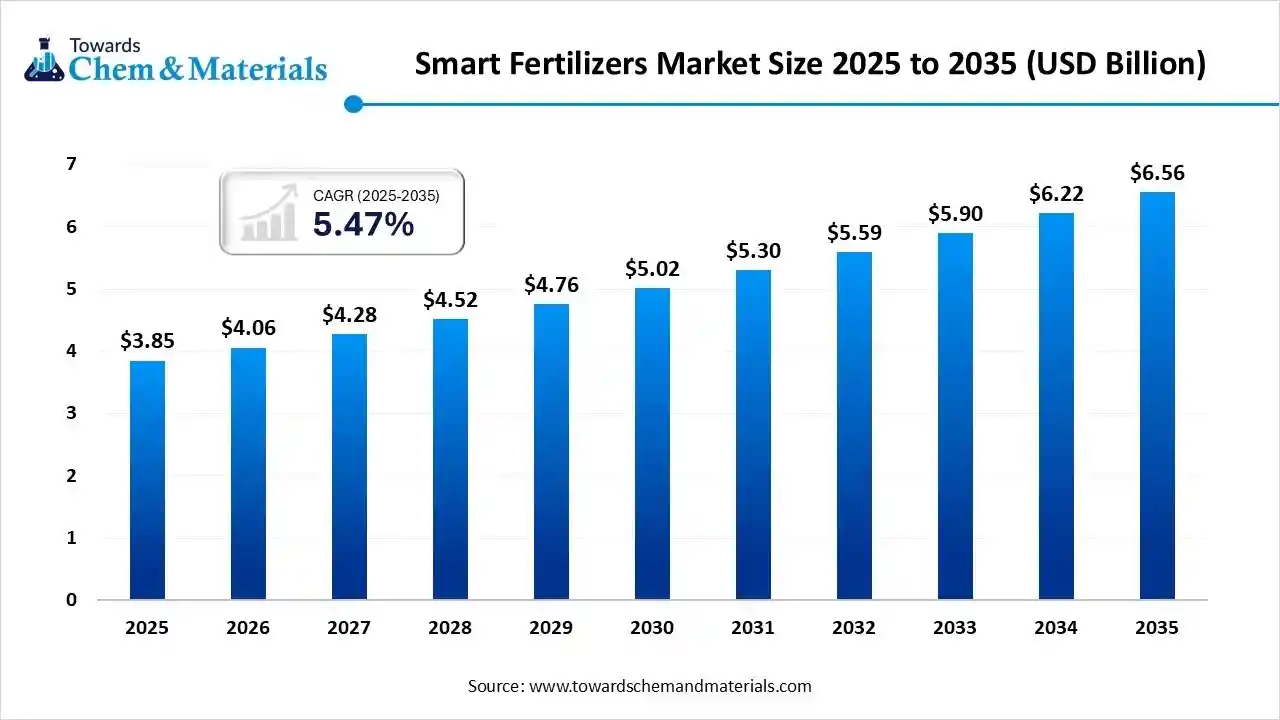
According to Towards Chemical and Materials Consulting, the global smart fertilizers market size was valued at USD 3.85 billion in 2025 and is expected to hit around USD 6.56 billion by 2035 at a CAGR of 5.47% from 2026 to 2035.
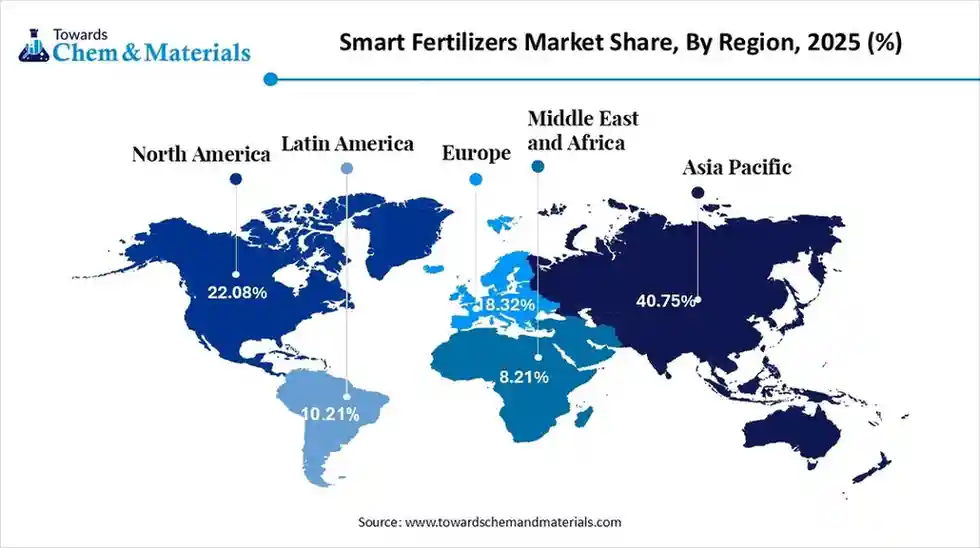
Ottawa, Dec. 16, 2025 (GLOBE NEWSWIRE) -- The global smart fertilizers market size was estimated at USD 3.85 billion in 2025 and is predicted to increase from USD 4.06 billion in 2026 and is projected to reach around USD 6.56 billion by 2035, The market is expanding at a CAGR of 5.47% between 2026 and 2035. Asia Pacific dominated the smart fertilizers market with a market share of 40.75% the global market in 2025. Increasing global demand for sustainable agriculture to improve crop yields and reduce environmental impact is driving the adoption of smart fertilizers. A study published by Towards Chemical and Materials a sister firm of Precedence Research.
Download a Sample Report Here@ https://www.towardschemandmaterials.com/download-sample/6071
What are Smart Fertilizers?
The smart fertilizers market is growing as modern agriculture increasingly adopts advanced nutrient solutions that enable controlled and responsive nutrient release based on crop and soil requirements. These fertilizers help improve nutrient efficiency, support soil health, and reduce environmental impact, aligning with the shift toward sustainable and precious farming practices. Rising focus on innovative agricultural inputs and environmentally responsible farming continues to support the expansion of the market.
Request Research Report Built Around Your Goals: sales@towardschemandmaterials.com
Smart Fertilizers Market Report Highlights
- By region, Asia Pacific led the smart fertilizers market with the largest revenue share of over 40.75% in 2025.
- By product type, the controlled-release fertilizers (CRF) segment led the market with the largest revenue share of 40.90% in 2025.
- By crop type, the grains and cereals segment led the market with the largest revenue share of 46.11% in 2025.
- By application type, the soil application segment accounted for the largest revenue share of 60.57% in 2025.
- By end use, the agriculture segment dominated with the largest revenue share of 81.13% in 2025.
How to Use New Generation Smart Fertilizer?
Smart fertilizer optimizes the nutrient balance by being applied according to plant needs. It also provides long-term nutrient replenishment thanks to its controlled release feature. Therefore, plants receive the nutrients they need over time. In this way, environmentally friendly agriculture is supported by preventing excess fertilizer use. It should be applied in doses based on soil analysis, ensuring healthy plant growth and efficient production. Therefore, the amount and frequency of use should be adjusted according to the developmental stage of the plant. Furthermore, smart fertilizers can be applied through irrigation systems or directly to the soil. In this way, the fertilization process becomes more effective and efficient. In this case, both agricultural costs are reduced and product quality is improved. Moreover, conscious use is important for the protection of soil and water resources.
Which Crops Are Smart Fertilizers Used For?
Smart fertilizers have been developed to suit the nutrient needs of different crops. They are also widely used on cereals, vegetables and fruit trees. Therefore, it increases the yield of cereals such as wheat, barley and corn. In this way, it supports sustainability by maintaining the nutrient balance of the soil. Furthermore, its use in vegetables improves product quality and shelf life. In this case, healthy growth is ensured in crops such as tomatoes, peppers and cucumbers. Therefore, it also optimizes nutrient absorption in fruit trees. It also contributes to a better taste of fruits such as apples, oranges and grapes. In this way, harvest yields increase and environmental impacts decrease. In this case, soil structure is preserved and water resources are used efficiently. Smart fertilizers are also applied to tea, coffee and other industrial crops.
Which Crops Are Smart Fertilizer Varieties Used For?
Smart fertilizers have been developed to increase yields in different agricultural crops. They are also widely used in cereals, vegetables, fruits and legumes. Therefore, it maintains nutrient balance in cereals such as wheat, maize, barley and rice. In this way, it promotes healthy growth by supporting root development. It also improves product quality in vegetables such as tomatoes, peppers, eggplants and cucumbers. In this case, the shelf life of vegetables is extended. The flavor is also preserved. Therefore, it is also an effective nutritional supplement for fruit trees. It also increases the yield of fruits such as apples, oranges, bananas and grapes. In this way, the harvest becomes more efficient and economical. It optimizes the nitrogen balance in legumes like lentils, chickpeas, and beans. Additionally, it is widely used in industrial crops. Therefore, it balances the nutrient level of the soil in crops such as tea, coffee, cotton and sunflowers.
Immediate Delivery Available | Buy This Premium Research Report@ https://www.towardschemandmaterials.com/checkout/6071
Smart Fertilizers Market Report Scope
| Report Attribute | Details |
| Market size value in 2026 | USD 4.06 Billion |
| Revenue forecast in 2035 | USD 6.56 Billion |
| Growth rate | CAGR of 5.47% from 2026 to 2035 |
| Actual data | 2018 - 2024 |
| Forecast period | 2025 - 2035 |
| Quantitative units | Volume in kilotons, revenue in USD million/billion, and CAGR from 2026 to 2035 |
| Report coverage | Revenue & Volume forecast, company ranking, competitive landscape, growth factors, and trends |
| Segments covered | By Product Type, By Crop Type, By Application Method, By End-Use Sector, By Region |
| Regional scope | North America; Europe; Asia Pacific; Latin America; MEA |
| Country scope | U.S.; Canada; Mexico; Brazil; Argentina; Germany; UK; Italy; Spain; France; China; Japan; South Korea; Saudi Arabia; South Africa |
| Key companies profiled | BASF SE; Nutrien Ltd.; ICL Group; Haifa Chemicals; Yara International; Dakota; The Mosaic Company; Haifa Group; K+S Aktiengesellschaft |
For more information, visit the Towards Chemical and Materials website or email the team at sales@towardschemandmaterials.com| +1 804 441 9344
Private Industry Investments for Smart Fertilizers:
- Yara International ASA: A Norwegian chemical company focused on crop nutrition and precision farming to boost agricultural output and environmental responsibility.
- Nutrien Ltd.: The largest potash producer globally and a key provider of nitrogen and phosphate, offering complete crop input options through its international system.
- The Mosaic Company: A major producer and seller of concentrated phosphate and potash crop nutrients, supplying essential NPK products for improved efficiency.
- BASF SE: This German chemical company provides specialized micronutrient and crop protection products, using extensive global R&D to advance agricultural output and environmental friendliness.
-
Coromandel International Ltd.: An Indian company manufacturing organic fertilizers, unique nutrients, and bio-pesticides, with a significant emphasis on R&D and a substantial agri-retail presence in India.
What Are the Major Trends in The Smart Fertilizers Market?
- Growing integration of artificial intelligence and advanced analytical tools to optimise nutrient release and decision-making in fertilizer solutions.
- Increasing focus on climate-adaptive release mechanisms that adjust nutrient delivery in response to environmental conditions.
- Emergence of microbial-triggered nutrient release fertilizers that respond to biological activity in soil for improved efficiency.
- Expansion from traditional controlled release products to intelligent systems using sensors, nanotechnology, and responsive coatings.
- Rising adoption of precision farming practices that combine smart fertilizers with digital agriculture technologies.
How Does AI Influence the Growth of the Smart Fertilizers Industry in 2025?
Artificial intelligence is shaping the smart fertilizers landscape by enabling precision nutrient management through real time data analysis from soil sensors, weather conditions, and crop health indicators, which helps determine the exact amount and timing of fertilizer application needed for optimal plant growth, reduces waste and environmental impact, and supports more efficient and sustainable farming practices, this enhanced precision and decision making capability encourages wider adoption of smart fertilization technologies and contributes to the overall expansion of the smart fertilizers industry.
Market Opportunity
Can Sustainable Farming Drive Smart Fertilizer Adoption?
Smart fertilizers create an opportunity to support sustainable agriculture by improving nutrient efficiency and reducing environmental stress on soil and water systems. Their ability to align nutrient release with plant needs encourages eco-friendly farming practices and long-term soil health.
Can Advanced Technologies Improve Fertilizer Efficiency?
The integration of technologies such as artificial intelligence, sensors, and nanotechnology opens opportunities for smarter nutrient delivery and better crop management. These innovations help farmers optimise fertilizer use while minimising losses and environmental impact.
Immediate Delivery Available | Buy This Premium Research Report@ https://www.towardschemandmaterials.com/checkout/6071
Smart Fertilizers Market Segmentation Insights
Why Controlled-Release Fertilizers Segment Dominated the Smart Fertilizers Market in 2025?
The controlled-release fertilizers (CRF) segment dominated the market as these products are designed to release nutrients gradually in response to soil and environmental conditions, which supports efficient nutrient uptake and minimizes losses caused by leaching or volatilisation. Farmers increasingly favour controlled release formulations because they help improve crop productivity while reducing the frequency of fertilizer application, making them suitable for large-scale agricultural operations.
The nano-fertilizers segment is expected to expand rapidly as advancements in nanotechnology enable precise nutrient delivery at the cellular level, improving nutrient absorption efficiency in crops. These fertilizers help reduce nutrient wastage and environmental impact while supporting better crop performance under diverse soil conditions. The growing emphasis on precision agriculture and innovative farming inputs has increased interest in Nano-based formulations, particularly among technologically progressive farming systems.
Crop Type Insights:
Which Crop Type Segment Held the Dominating Share of the Smart Fertilizers Market in 2025?
The grains and cereals segment dominated the market due to the extensive cultivation of staple crops that require consistent and efficient nutrient management to maintain yield stability. Smart fertilizers are increasingly used in cereal farming to support soil fertility and optimise nutrient availability throughout the crop growth cycle. The large cultivation area associated with grains and cereals makes efficiency and sustainability critical, encouraging the adoption of advanced fertilizer solutions.
The fruits & vegetables segment is projected to witness rapid growth as growers focus on improving crop quality, yield consistency, and nutrient efficiency. Smart fertilizers support precise nutrient control, which is essential for high-value horticulture crops that are sensitive to nutrient imbalance. The increasing demand for fresh produce and protected cultivation practices has further encouraged the use of advanced fertilisation technologies in this segment. These factors collectively contribute to the accelerating adoption of smart fertilizers in fruit and vegetable cultivation.
Application Type Insights:
How Soil Application Segment Lead the Smart Fertilizers Market In 2025?
The soil application segment led the market because it allows nutrients to be delivered directly to the root zone, assuring steady availability over time. This method supports effective nutrient absorption while improving soil structure and microbial activity. Soil application remains widely used due to its compatibility with existing farming practices and its suitability for a broad range of crops. The integration of smart formulations into traditional soil application methods has strengthened its continued relevance.
The fertigation segment is expected to expand as it combines irrigation and fertilisation into a single, efficient system that enhances nutrient precision and water use efficiency. This approach supports controlled nutrient delivery and reduces operational inefficiencies, making it attractive for modern and intensive farming systems.
End Use Insights:
Which End-use Segment Leads the Smart Fertilizers Market?
The agriculture segment dominated the market as these products are increasingly integrated into conventional and modern farming systems to enhance productivity and sustainability. Smart fertilizers help address challenges related to soil degradation and inefficient nutrient use in large-scale agricultural operations. Their adaptability across diverse crop types and farming conditions has reinforced their importance in agricultural applications. Continued emphasis on sustainable food production further supports this segment.
The greenhouses and controlled environment agriculture segment is expected to grow rapidly due to the increasing adoption of precision input management in protected cultivation systems. Smart fertilizers support controlled nutrient delivery that aligns with the regulated growing conditions of greenhouses, improving crop performance and resource efficiency. The rising focus on year-round production and high-quality yields has accelerated the use of advanced fertilisation technologies in controlled environments.
➤ Contact Us: sales@towardschemandmaterials.com | ☎ +1 804 441 9344
Regional Insights
Why Is Asia Pacific Dominating the Smart Fertilizers Market?
The Asia Pacific smart fertilizers market size was valued at USD 1.57 billion in 2025 and is expected to reach USD 2.68 billion by 2035, growing at a CAGR of 5.49% from 2026 to 2035.
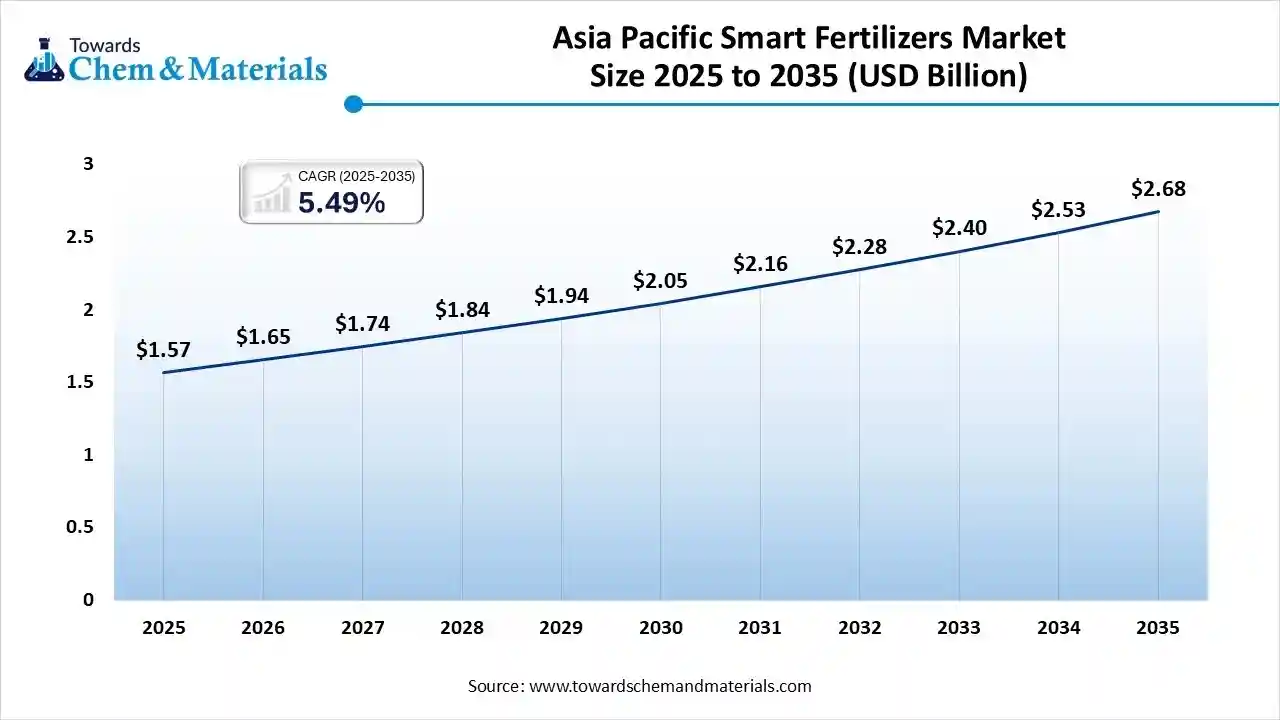
The Asia Pacific holds a leading position in the market, driven by its large agricultural landscape, growing adoption of modern farming practices, and strong government support for agricultural innovation and soil health improvement, which together have increased the uptake of advanced fertilisation solutions across the region.
The extensive cultivation of staple crops and the need to boost productivity while managing environmental impact have made smart fertilizers more attractive to farmers throughout the Asia Pacific, reinforcing the region’s dominant role in the global market.
China Smart Fertilizers Market Trends
Within the Asia Pacific, China stands out as a major contributor to smart fertilizer demand due to rapid greenhouse gas expansion, substantial investment in agricultural technologies, and widespread adoption of advanced nutrient management methods. These factors have helped Chinese farmers integrate smart fertilisation approaches into large-scale grain and vegetable production more readily than in many other markets.
Why is Europe the Fastest-Growing Region?
Europe is expected to be the fastest growing region in the market due to a pronounced shift toward environmentally friendly and sustainable farming practices that emphasize reducing nitrogen emissions and improving soil health, framers across European countries are increasingly seeking advanced fertilizer solutions that align with strict environmental policies and sustainability goals, prompting greater interest in smart nutrients that support precision nutrient management while mitigating ecological impact.
Germany Smart Fertilizers Market Trends
Within the broader European smart fertilizers landscape, Germany emerges as a prominent country due to its strong emphasis on precision agriculture, robust research efforts in nutrient-efficient solutions, and widespread use of digital farming tools such as soil mapping and advanced sensors that complement smart nutrient solutions, positioning the country as a key market within the European region’s growth trajectory.
Top Companies in the Smart Fertilizers Market & Their Offerings:
- EuroChem Group AG: Offers inhibited fertilizers like ENTEC® and UTEC® to improve nitrogen efficiency and reduce emissions.
- K+S AG: Focuses on specialty water-soluble fertilizers under the solufamily® and KALISOP® ranges from natural sources.
- ICL Group Ltd.: Features pioneering controlled-release technology with Osmocote and the biodegradable eqo.s coating.
- The Mosaic Company: Provides premium balanced crop nutrition products like MicroEssentials®, which integrate multiple nutrients into every granule for uniform distribution.
- CF Industries Holdings, Inc: Emphasizes the development of low-carbon and green ammonia for more sustainable nitrogen-based nutrient solutions.
- Yara International ASA: Delivers a wide range of specialty nutrients and digital farming tools, including its high-efficiency YaraBela and YaraLiva series.
- Nutrien Ltd: Offers integrated crop solutions including high-performance ESN® (Environmentally Smart Nitrogen), a polymer-coated urea for controlled release.
- Coromandel International Limited: Offers a diverse portfolio of specialty nutrients and unique "GroPlus" formulations tailored for specific regional needs.
- BASF SE: Supplies advanced chemical additives for fertilizers, such as the nitrification inhibitor Vibelsol® and urease inhibitor Limus®, to minimize nitrogen loss.
- Bayer CropScience AG: Integrates digital agronomy with nutrient management, focusing on optimizing fertilizer use through precision platforms like Climate FieldView.
- COMPO EXPERT GmbH: Specializes in high-quality specialty fertilizers including NovaTec® (with nitrification inhibitors) and Basacote® (controlled-release).
- Adama Ltd. (part of Syngenta Group): Provides integrated crop protection and nutrition solutions, focusing on biostimulants and specialty nutrients.
- Kingenta Ecological Engineering Co., Ltd.: A major Chinese producer of compound fertilizers and slow-release technologies to improve nutrient utilization.
- Koch Industries (Koch Fertilizer, LLC): Markets advanced efficiency products like SUPERU® and ANVOL® which utilize dual inhibitors to protect nitrogen from loss.
- Gujarat State Fertilizers & Chemicals Ltd. (GSFC): Produces specialized water-soluble fertilizers and fortified fertilizers like Zincated Urea.
- Indian Farmers Fertilizer Cooperative Limited (IFFCO): Revolutionized the industry with its high-efficiency Nano Urea and Nano DAP liquid fertilizers.
- SQM S.A.: A global leader in specialty plant nutrition, providing premium potassium nitrate and water-soluble blends for fertigation systems.
- Haifa Group: Known for its Multi-K™ potassium nitrate and Multicote™ controlled-release fertilizers for precision horticulture.
- Sinofert Holdings Limited: Focuses on high-efficiency, sustainable fertilizers through extensive R&D and distribution networks within China.
- Helena Agri-Enterprises, LLC: Offers a specialized line of AGRI-FLO® liquid nutrients and CoRoN® controlled-release foliar nitrogen for enhanced crop performance.
More Insights in Towards Chemical and Materials:
- Specialty Fertilizers Market Size to Hit 49.33 Million Tons by 2034
- Fertilizers Market Size to Hit USD 380.16 Billion by 2035
- Phosphate Fertilizers Market Size to Hit $ 124.97 Bn by 2034
- Controlled Release Fertilizers Market Size to Reach USD 4.49 Billion by 2034
- Organic Fertilizers Market Size to Hit USD 23.35 Billion by 2035
- Smart Fertilizers Market Size to Reach USD 6.56 Billion by 2035
- Liquid Fertilizers Market Size to Worth USD 4.93 Billion by 2035
- Agriculture Fertilizers Market Size to Surpass USD 332.79 Billion by 2035
- Europe Fertilizers Market Size to Hit USD 95.30 Billion by 2035
- U.S. Fertilizers Market Size to Reach USD 47.28 Billion by 2034
- Asia Pacific Fertilizers Market Size to Reach USD 313.44 Bn by 2034
- U.S. Nitrogenous Fertilizer Market Size to Surpass USD 26.29 Bn by 2034
Smart Fertilizers Market Top Key Companies:
- BASF SE
- Nutrien Ltd.
- ICL Group
- Haifa Chemicals
- Yara International
- Dakota
- The Mosaic Company
- Haifa Group
- K+S Aktiengesellschaft
Recent Developments
- In October 2025, Guyana’s agriculture sector introduced the country’s first nanotechnology fertilizer, promising more efficient nutrient delivery and potentially higher yields with less input. The product was officially launched at the Burma Rice Research Station, making a key step toward modernizing local farming practices.
- In March 2025, ARB IOT Group unveiled an advanced AI-powered Smart AI Robot fertilizer system designed to automate and optimize fertilization in agriculture. This precision technology uses real-time soil data and machine learning to reduce fertilizer waste, enhance nutrient delivery, and support sustainable crop production across diverse plantations.
- In April 2024, Nitricity Inc. launched its first tonnage field test of locally-produced liquid calcium nitrate in Madera County, California, partnering with Olam Food Ingredients, Elemental Excelerator, and the Madera/Chowchilla RCD to scale climate-smart nitrogen fertilizer production.
Smart Fertilizers Market Report Segmentation
This report forecasts revenue growth at global, regional, and country levels and provides an analysis of the latest industry trends in each of the sub-segments from 2019 to 2035. For this study, Towards Chemical and Materials has segmented the global Smart Fertilizers Market
By Product Type
- Controlled-Release Fertilizers (CRF)
- Slow-Release Fertilizers (SRF)
- Stabilized Fertilizers
- Urease Inhibitors
- Nitrification Inhibitors
- Nano-Fertilizers
- Nano-Urea
- Nano-Micronutrients
- Other Nano-Formulations
- Liquid Smart Fertilizers
- Suspensions
- Solutions
- Bio-Fertilizers (as Smart/Precision Inputs)
- Nitrogen-Fixing Bio-Fertilizers
- Phosphate-Solubilizing Bio-Fertilizers
- Potassium-Mobilizing Bio-Fertilizers
- Coated Fertilizers
- Polymer-Coated Fertilizers (PCFs)
- Sulfur-Coated Fertilizers (SCFs)
- Polymer-Sulfur Coated Fertilizers (PCSFs)
- Other Coated Types
- Nitrogen-Based Smart Fertilizers
- Phosphorus-Based Smart Fertilizers
- Potassium-Based Smart Fertilizers
- Micronutrient-Based Smart Fertilizers
- Zinc
- Boron
- Manganese
- Iron
- Others (Copper, Molybdenum, etc.)
By Crop Type
- Grains and Cereals
- Rice
- Wheat
- Maize/Corn
- Others (Barley, Oats, etc.)
- Fruits and Vegetables
- High-Value Fruits
- Root Vegetables
- Leafy Vegetables
- Others
- Pulses and Oilseeds
- Soybeans
- Groundnut
- Canola/Rapeseed
- Others
- Commercial Crops/Cash Crops
- Cotton
- Sugarcane
- Plantation Crops (Tea, Coffee, Rubber)
- Others
- Turf and Ornamentals
By Application Method
- Soil Application (Broadcasting, Banding)
- Foliar Application
- Fertigation (Drip, Sprinkler)
- Seed Treatment
- Other Methods (Side-Dressing, Top-Dressing)
By End-Use Sector
- Agriculture (Open Field Farming)
- Horticulture and Floriculture
- Greenhouses and Controlled Environment Agriculture (CEA)
- Residential/Home Gardening and Landscaping
- Sports Turf and Golf Courses
By Regional
- North America
- Europe
- Asia Pacific
- Latin America
- Middle East & Africa
Immediate Delivery Available | Buy This Premium Research Report@ https://www.towardschemandmaterials.com/checkout/6071
About Us
Towards Chemical and Materials is a leading global consulting firm specializing in providing comprehensive and strategic research solutions across the chemical and materials industries. With a highly skilled and experienced consultant team, we offer a wide range of services designed to empower businesses with valuable insights and actionable recommendations.
Our Trusted Data Partners
Towards chem and Material | Precedence Research | Statifacts | Towards Packaging | Towards Healthcare | Towards Food and Beverages | Towards Automotive | Towards Consumer Goods | Nova One Advisor | Nutraceuticals Func Foods | Onco Quant | Sustainability Quant | Specialty Chemicals Analytics | TCM Blog
For Latest Update Follow Us: https://www.linkedin.com/company/towards-chem-and-materials/
USA: +1 804 441 9344
APAC: +61 485 981 310 or +91 87933 22019
Europe: +44 7383 092 044
Email: sales@towardschemandmaterials.com
Web: https://www.towardschemandmaterials.com/


Legal Disclaimer:
EIN Presswire provides this news content "as is" without warranty of any kind. We do not accept any responsibility or liability for the accuracy, content, images, videos, licenses, completeness, legality, or reliability of the information contained in this article. If you have any complaints or copyright issues related to this article, kindly contact the author above.
